
Operating playbook
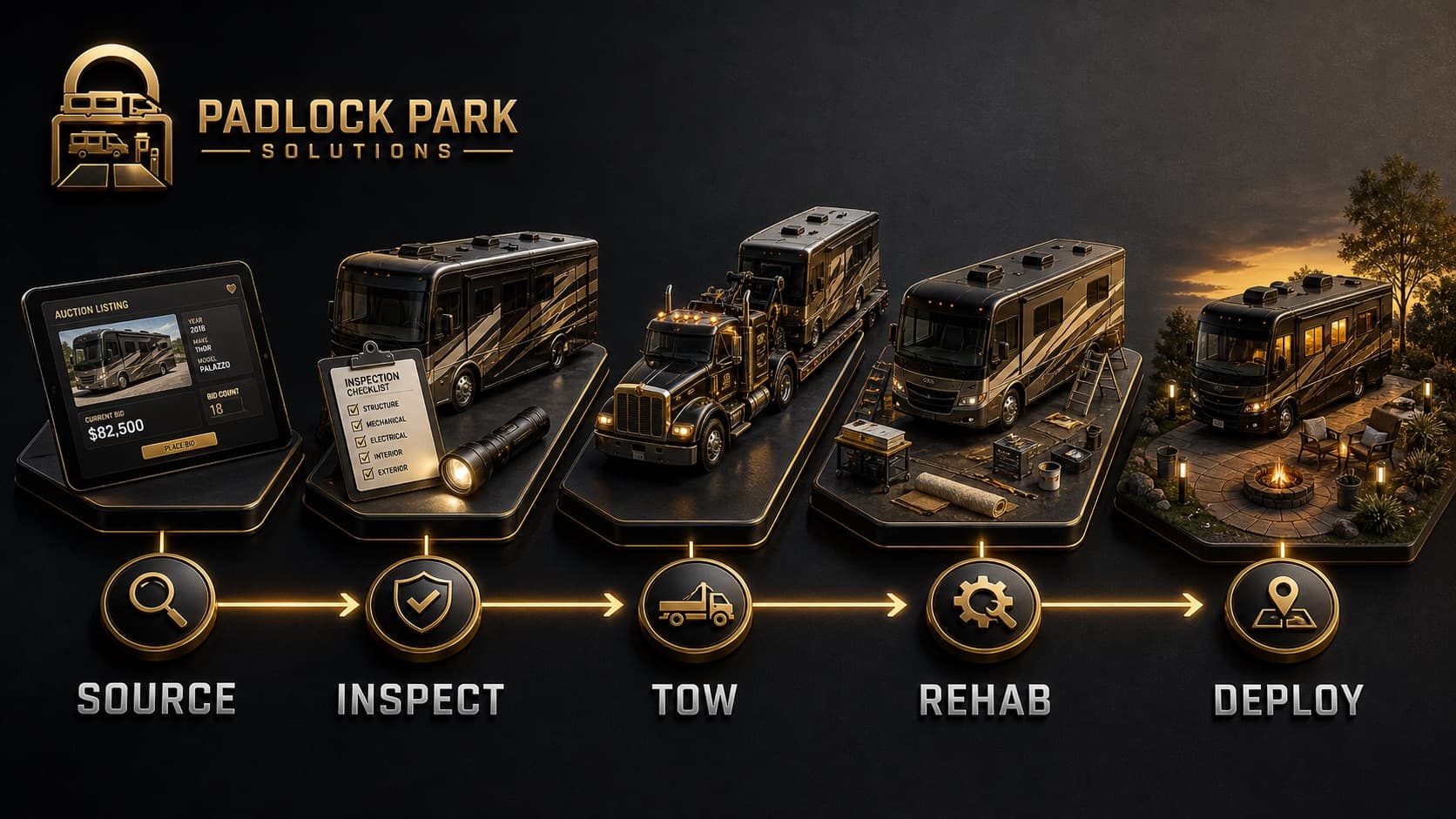
The pipeline, end to end.
Every stage from auction floor to first rent check. The same manual we hand operators on day one.
Step 01
Purpose & scope.
What this document is, and what it isn't.
The full pipeline from sourcing a salvage RV to placing a paying tenant in a deployed unit. The operational manual that backs the investment thesis.
What this is.
Acquisition criteria + sourcing channels + bid discipline. Bulk transport approach for single-region relocation. Standardized rehab scope and time/cost budget per unit. Site setup specification per unit position. Standardized SOPs for operator-and-helpers execution. Kill-switch rules that prevent cost creep at every stage.
What this is not.
Property management manual (occupancy, cleaning, guest interaction). Marketing or distribution playbook (Airbnb, direct booking, social). Financial model — see the financial workbook. Legal or zoning brief — see the zoning brief.
Step 02
The arbitrage.
Why salvage RV inventory is structurally mispriced — and how the model captures the gap.
Insurance companies write off motorhomes for engine failure, transmission failure, chassis damage, accident damage, and total loss events. These units carry a salvage title, cannot be financed conventionally, and are auctioned to recover loss reserve. The auction market values them as vehicles — depreciated, non-drivable, unfinanceable. It does not value them as habitations.
A 30–40 foot Class A motorhome with a blown engine still contains an intact, habitable interior: bedroom, full kitchen, bathroom with shower, living area, dinette, climate control, 12V and 120V electrical, propane systems, holding tanks. Replacement cost of the same square footage as a residential structure is $40,000–$80,000+. Auction price for the salvaged unit is typically $1,500–$3,500.
The vehicle is the liability. The interior is the product. The arbitrage is the gap between the unit's vehicle salvage value and its value as stationary habitable space.
No financing.
Salvage titles cannot be conventionally financed; this disqualifies the entire retail RV buyer pool.
No mobility.
Average buyer cannot drive or transport a non-functional Class A; physical retrieval is a barrier.
Retail repair uneconomic.
Salvage units are treated as parts donors or scrap by most buyers; full repair is uneconomic at retail labor rates.
Repair cost exceeds drivable value.
Engine plus transmission rebuild on a Class A chassis runs $15K–$30K — exceeds the unit's drivable resale value.
Step 03
Sourcing.
Where the units come from. Channels, criteria, bid discipline.
Primary sourcing market: Las Vegas. Highest concentration of salvage RV inventory in the western US. Mature salvage ecosystem: high RV ownership, hot climate that accelerates mechanical failure, multiple commercial salvage yards within 50 miles, weekly Copart and IAA RV inventory, established tow logistics, cash-buyer culture.
The hard rule: maximum acquisition price per unit is $2,500. No exceptions. If projected total deployment cost exceeds $7,500, the unit is not acquired. Bid discipline is the cap-enforcement mechanism applied at the source.
| Channel | How it works | Typical price | Notes |
|---|---|---|---|
| Copart auctions | Online bid; cash payment; pickup window | $1,500–$3,500 | Largest inventory; weekly auctions |
| IAA auctions | Online bid; cash payment; pickup window | $1,800–$3,500 | Comparable to Copart; check both |
| Salvagereseller.com | Brokered listings; direct purchase | $2,000–$4,000 | Pre-screened; less inventory |
| Regional salvage dealers | Direct relationship; cash; pickup | $1,500–$3,000 | Negotiable; relationship-driven |
| Private trade-ins | RV dealer trade-in inventory; cash | $1,500–$3,000 | Periodic; relationship-driven |
| Owner-direct | Facebook Marketplace, Craigslist, forums | $800–$2,500 | Highest value, slower; case-by-case |
Step 04
Inspection & acquisition discipline.
What is bought. What is rejected. The kill-switch rule.
Cash purchase only.
No financing. Cleared funds in escrow before bid placement.
Maximum bid: $2,500.
No deviation. Hard ceiling that protects total deployment basis.
Walk-away discipline.
Walk away from any unit failing inspection criteria. The cheapest unit is the one you don't buy.
Acquisition cadence.
2–3 units/week during active deployment phase. Pace is throttled by inspection capacity, not by inventory availability.
Out-of-scope by design.
Engine repair, transmission repair, chassis/frame repair, roof replacement, slide-out mechanism repair, major plumbing rebuild, black/grey tank replacement — all rejected at inspection.
Step 05
Logistics.
One-time tow. Bulk relocation. Per-unit transport at sub-retail rates.
Each unit is towed once. Once it lands at the property, it never moves again. The unit becomes stationary infrastructure. This is the single most important logistics decision in the model — by treating the unit as immobile from arrival forward, transport cost amortizes to a one-time event rather than an ongoing operating expense.
Transport is negotiated as a single regional relocation contract — not per-unit retail RV towing. Vegas to Mosca is approximately 700 miles. Multiple units batched per trip on flatbed or wheel-lift carrier. Operator-coordinated with cash payment and flexible scheduling.
| Dimension | Retail RV transport | Bulk salvage relocation |
|---|---|---|
| Service level | White-glove, on-demand | Schedule-flexible, no-frills |
| Pricing structure | $2/loaded mile + deadhead | Per-unit batched rate |
| Volume | Single unit | Multiple units per trip |
| Insurance | Full coverage required | Minimal — units already at salvage value |
| Operator involvement | Hands-off | Operator coordinates pickup + drop |
| Per-unit cost (700 mi) | $2,000–$2,500 | $400–$1,000 |
Step 06
Rehab pipeline.
Cosmetic + functional only. 5–7 days per unit. Standardized scope.
Each unit goes through a standardized rehab process on arrival. Scope is limited to cosmetic and functional work; structural and mechanical work is out of scope by design. Standardization prevents cost creep — same scope, same materials, same vendors, same finish. Throughput: two units in active rehab simultaneously per operator/helper team.
Monthly output: 8–10 units per month at full pace. Phase 1 launch (8 units): roughly 5 weeks of active rehab time. Phase 2 fast-follow (+4 units): roughly 2.5 weeks additional.
| Task | Time | Cost range |
|---|---|---|
| Deep clean — interior + exterior pressure wash | 1 day | $50 |
| Replace carpet / flooring | 1 day | $300–$500 |
| Paint interior | 1–2 days | $150–$300 |
| Replace soft furnishings (cushions, curtains) | Same day | $200–$400 |
| Install flatscreen TV | 1 hour | $150 |
| Verify and repair 12V + 120V electrical (Sol-Ark competency) | 0.5–1 day | $0–$300 |
| Verify and repair plumbing + tanks | 0.5 day | $0–$200 |
| Verify and certify propane system (licensed inspection) | 0.5 day | $100 |
| Roof coating — Son Shield ceramic paint | 1 day | $300 |
| Final QC + photo shoot for listings | 0.5 day | — |
| TOTAL | 5–7 days | $1,250–$2,250 |
Step 07
Site setup.
Each unit becomes a defined campsite — not a parked trailer.
Each unit is positioned on the property in an amphitheater layout — windshields oriented toward the Sangre de Cristo / Blanca Peak view, units spaced for privacy, no unit within another's primary sightline. The site around each unit is dressed as a defined campsite: pad, hookups, fire pit, camp chairs, charcoal grill, native landscaping.
The product being sold is the experience of camping in an RV — not the rental of a stationary trailer. The fire pit, the chairs, the grill, the spaced layout, and the unobstructed view are what differentiate this from a mobile-home park. Cost per site dressing is under $500 in materials. The pricing differential vs. mobile-home park rents is multiples of that.
| Element | Specification | Cost |
|---|---|---|
| Pad | Concrete or graded gravel, leveled, standardized dimensions | $300–$600 per pad |
| Power hookup | 30/50 amp service from central solar/battery bank | $200–$400 / underground run |
| Water hookup | Spigot from main water tank, underground line | $100–$200 / underground run |
| Sewer connection | Connection to central septic per permit | $200–$400 / connection |
| Fire pit | Stone-rimmed, graveled base, 4ft diameter | $50–$100 materials, DIY |
| Camp furniture | Two folding camp chairs, steel charcoal grill | $80–$120 per site |
| Site landscaping | Native plantings, decorative rocks, defined borders | Under $100 per site |
| Pet enclosure (premium tier) | 4ft fence around defined pet area, gate | $200–$400 per fenced site |
| TOTAL site dressing | — | $1,000–$1,500 per site |
Step 08
Standardization.
The discipline that makes this repeatable.
Standardization is the operational principle that converts this from a project into a system. Same scope, same materials, same vendors, same finish — every unit, every site. Variance is the enemy of margin in this model.
What is intentionally not standardized: each unit retains its original RV interior layout — no two are identical. This is a feature, not a bug. Tenants prefer the variety; the operator does not pay for new construction. Site landscaping varies based on terrain — operator and helpers improvise within budget guidelines.
Acquisition.
Inspection criteria, bid limits, kill-switch rules.
Logistics.
Carrier, route, batch sizes, payment terms.
Rehab.
Scope of work, materials sourcing, time budget per unit.
Site setup.
Pad spec, hookup design, fire pit, furniture, landscaping guidelines.
Listings.
Photo standard, copy template, pricing tiers, booking flow.
Operations.
Cleaning protocols, maintenance schedules, emergency response procedures.
Step 09
End-to-end timeline — single unit.
From auction lot to revenue-generating lodging in 30–45 days.
Multiple units run in parallel pipeline. Phase 1 launch (8 units) is achievable in approximately 90 days from first acquisition. Phase 2 fast-follow (+4 units) adds 30–45 days to reach 12-unit capacity.
| Day | Stage | Activity |
|---|---|---|
| Day 0 | Sourced | Unit identified at Vegas auction; inspection passed; bid placed |
| Day 1–3 | Acquired | Auction win confirmed; cash payment cleared; title transferred; pickup scheduled |
| Day 5–7 | Pre-tow | Pre-tow inspection; carrier coordination; documentation |
| Day 10–14 | Relocated | Unit transported Vegas → Mosca; arrival inspection at property |
| Day 15 | Rehab start | Standardized rehab pipeline begins |
| Day 20–22 | Rehab complete | Cosmetic + functional rehab done; QC pass; Son Shield applied |
| Day 23–25 | Site setup | Unit positioned; pad, hookups, fire pit, furniture, landscaping |
| Day 26–28 | Listing | Photo shoot; listings created on direct site + Airbnb; pricing locked |
| Day 30–45 | Deployed | First tenant placed; revenue begins; long-term priority allocation |
Step 10
Unit-level economics — three cases.
What each unit costs. What each unit earns. The arithmetic.
Three case scenarios for total deployment cost. Operator case is the cost most likely realized at full operator capability. Base case is the cost used in headline financial projections. Hard cap variant is the ceiling — if any line drives total above $7,500, the unit is rejected.
| Cost component | Operator case | Base case | Hard cap variant |
|---|---|---|---|
| Salvage RV acquisition | $1,750 | $2,500 | $3,000 |
| Bulk towing (Vegas → Mosca) | $600 | $1,000 | $1,500 |
| Standardized rehab | $1,300 | $1,500 | $2,000 |
| Site prep + setup | $1,500 | $1,500 | $1,500 |
| Buffer / contingency | $0 | $0 | $1,500 |
| TOTAL | $5,150 | $6,500 | $9,500 |
| vs. $7,500 cap | Under cap | Under cap | Above cap — REJECT |
Step 11
Three ways the unit gets paid.
Long-term tenant. Short-term fill. Blended. Each unit, the operator picks.
Same unit. Three distinct revenue paths. The model supports any of them per unit, and supports rotation between paths over time.
Per-unit yield math at base case: $5,500 deployment cost, replacement cost equivalent $40K–$80K, 85–93% basis discount, blended ~$1,100/month revenue, ~$650–$750/month net per unit, ~$8K–$9K/year net, payback per unit ~7–8 months at this blended ~$1,100/month revenue (vs ~10 months on tenant-only at ~$750/month), annual yield on basis 150%–165%.
| Revenue path | Monthly | Annual | Note |
|---|---|---|---|
| Long-term tenant | $700 | $8,400 | Priority occupancy; 12-month leases; predictable cash flow |
| Short-term fill (50% occ) | $1,425 | $17,100 | Rotating; fills idle inventory; tourism-corridor pricing |
| Blended (8 LT + 4 ST mix) | ~$1,100 | ~$13,200 | Project-level average across the 12-unit Phase 1+2 deployment |
Step 12
Pipeline risk & failure modes.
What goes wrong at each stage. How the kill-switch handles it.
| Stage | Failure mode | Mitigation |
|---|---|---|
| Sourcing | Auction prices spike above $2,500 max bid | Walk away; switch sourcing channel; pause acquisition until market normalizes |
| Sourcing | Inventory shortage in Vegas market | Expand sourcing radius (PNW, N. CA); accept transport cost delta |
| Acquisition | Hidden water damage discovered on arrival | Kill-switch — sell for parts; absorb cost against acquisition reserve |
| Acquisition | Title issues post-purchase | Auction houses guarantee title; refund process; write off if no recovery |
| Logistics | Bulk transport rate increases above $1,000/unit | Renegotiate; switch carrier; reduce batch frequency; pause acquisition |
| Logistics | Carrier damages unit in transit | Carrier insurance claim; replacement unit sourcing |
| Rehab | Scope expands beyond standardized budget | Kill-switch — unit rejected; sold for parts; cost absorbed |
| Rehab | Materials cost spike on standardized SKUs | Bulk advance purchase; lock pricing on next deployment cohort |
| Site setup | Pad/hookup runs encounter underground obstacles | Reroute or relocate unit position; site flexibility built in |
| Site setup | Septic capacity reached at 16+ units | Phase 2 engineering review pre-trigger; commercial septic addition contingency |
| Listing | Initial occupancy ramp slower than projected | Aggressive short-term pricing; long-term ad spend; helper-trade fill |
| Operating | RV system failure post-deployment | Maintenance reserve ($14.4K/yr); helper team; spare parts inventory |
Step 13
Replication.
How this scales beyond the originating site.
The Mosca site is the proof-of-concept anchor. Once stabilized, the model is replicable across additional low-basis properties in the same operating footprint. Each replicated site operates as a standalone P&L. Sites are aggregated under a holding entity for institutional sale once 3–5 sites are stabilized and producing 5+ years of operating history. Roll-up is the exit, not the operating model.
Land basis under $1,000/acre.
Low-cost rural acreage that supports the unit-economics math without land cost overwhelming the deployment basis.
Existing well + septic, or clean permit path.
Avoid municipal-water-and-sewer dependency; the model targets owner-controlled infrastructure.
Flexible zoning — no HOA, no covenants.
AC or equivalent agricultural-commercial designation. Long-term-stay-friendly.
Within 1,000 miles of a salvage RV market.
Vegas, PNW, Northern California, Phoenix. Bulk transport math holds inside that radius.
Tourism driver or remote-worker catchment within 30 minutes.
Demand profile that supports both long-term tenant and short-term fill paths.
Notable view or experience hook.
Mountains, water, dark sky. The view is what differentiates the product from mobile-home parks.
Step 14
Summary.
The model in one paragraph.
Every dollar in this model traces to one of the operating decisions documented above. Every operating decision traces to a kill-switch rule that prevents drift. The result is a system that can be operated by one person at Phase 1, scaled to a manager + helpers at Phase 2+, and replicated to a portfolio over time.
Buy salvage RV inventory at vehicle-scrap pricing. Tow each unit once to a low-basis rural property with a view. Standardize rehab to cosmetic + functional only. Set up each unit as a defined campsite. Deploy to long-term-anchored occupancy with short-term fill. Repeat at $7,500 hard-cap discipline. Scale on occupancy proof, not occupancy projection. Replicate.